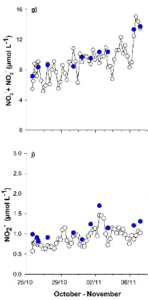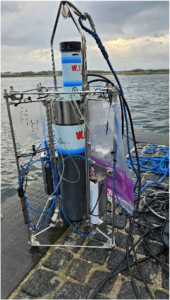
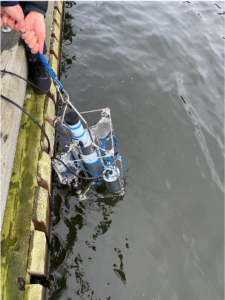
A new BioGeoSea study shows how automated, in-situ sensors can change our understanding of nutrient dynamics in coastal waters – and help inform better environmental management. By using an in-situ nitrogen sensor, the study demonstrates that high-frequency measurements capture short-term variability that conventional monitoring programs often miss.
Key findings
• In-situ sensors effectively capture rapid (within ~6 hours) natural variability in nitrate and nitrite concentrations, compared to traditional low-frequency (daily) sampling.
• Sampling time strongly affects how representative measurements are for daily averages—and the most representative time varies seasonally.
• Short-term variability is driven by river inputs, sediment resuspension, and biological activity.
These insights highlight why automated sensor technologies are needed for improving coastal monitoring, modeling, and management under changing environmental conditions.
Read the paper on springer: “Using automated sensors to unravel short-term nitrogen dynamics in coastal waters” (DOI https://lnkd.in/eBx9qf3b)
Authors: Christian Lønborg, Peter A.U. Staehr, Cátia Carreira
Paper link: Lønborg, C., Stæhr, P.A.U. & Carreira, C. Using automated sensors to unravel short-term nitrogen dynamics in coastal waters. Biogeochemistry 169, 37 (2026).
https://doi.org/10.1007/s10533-026-01326-y
 .
.