

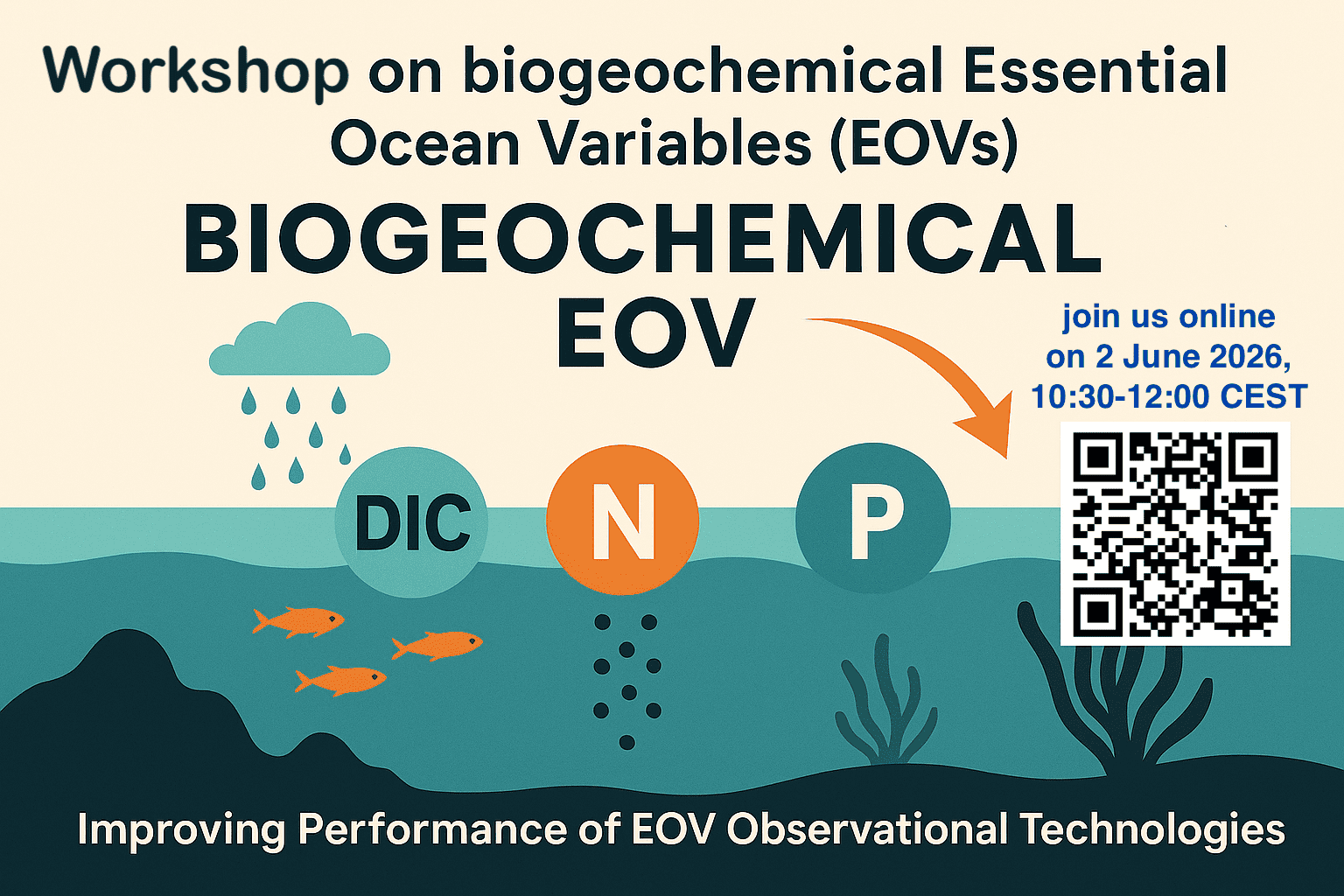
Are you working with EOVs? Do you make use of reference samples in your observations?
Then join our Online Workshop!
on 2 June, 10:30-12:00 CEST (9:30-11:00 BST)
online, for your participation, please register here.
Essential Ocean Variables are key variables critical for understanding the state and health of the ocean. International bodies such as the Global Ocean Observing System (GOOS) oversee frameworks for identifying EOVs and defining specification sheets, which outline the supporting measurable variables in each category and how they’re used to characterise relevant ocean processes
In this workshop we will discuss the current use of reference material across physical, chemical and biological ocean observations, including EOVs such as inorganic carbon, nitrous oxide, inorganic nutrients, transient tracers, and oyxgen. During this workshop we will outline recommendations for the next decade as part of the update of the essential ocean variable (EOV) specification sheets. We will seek to learn how researchers of different EOVs collect, maintain, and use reference material and what they feel current limitations are in using these references for EOV observation and research.
So, if you want to have your say please get involved! it is important to get the community’s input for this.
For your participation, please register here.
Organizers:
Trevor Sloughter, PhD, Postdoctoral Research Fellow, Department of Geography, University of Exeter, UK
Ute Schuster, Associate Professor, Faculty of Environment, Science and Economy, University of Exeter, UK
Christian Lønborg, Senior Researcher, Department of Ecoscience, Marine Diversity and Experimental Ecology, Aarhus University, Denmark
________________________________________________________________________________
*This workshop is part of the EU project BioGeoSea within Work Package 2.