

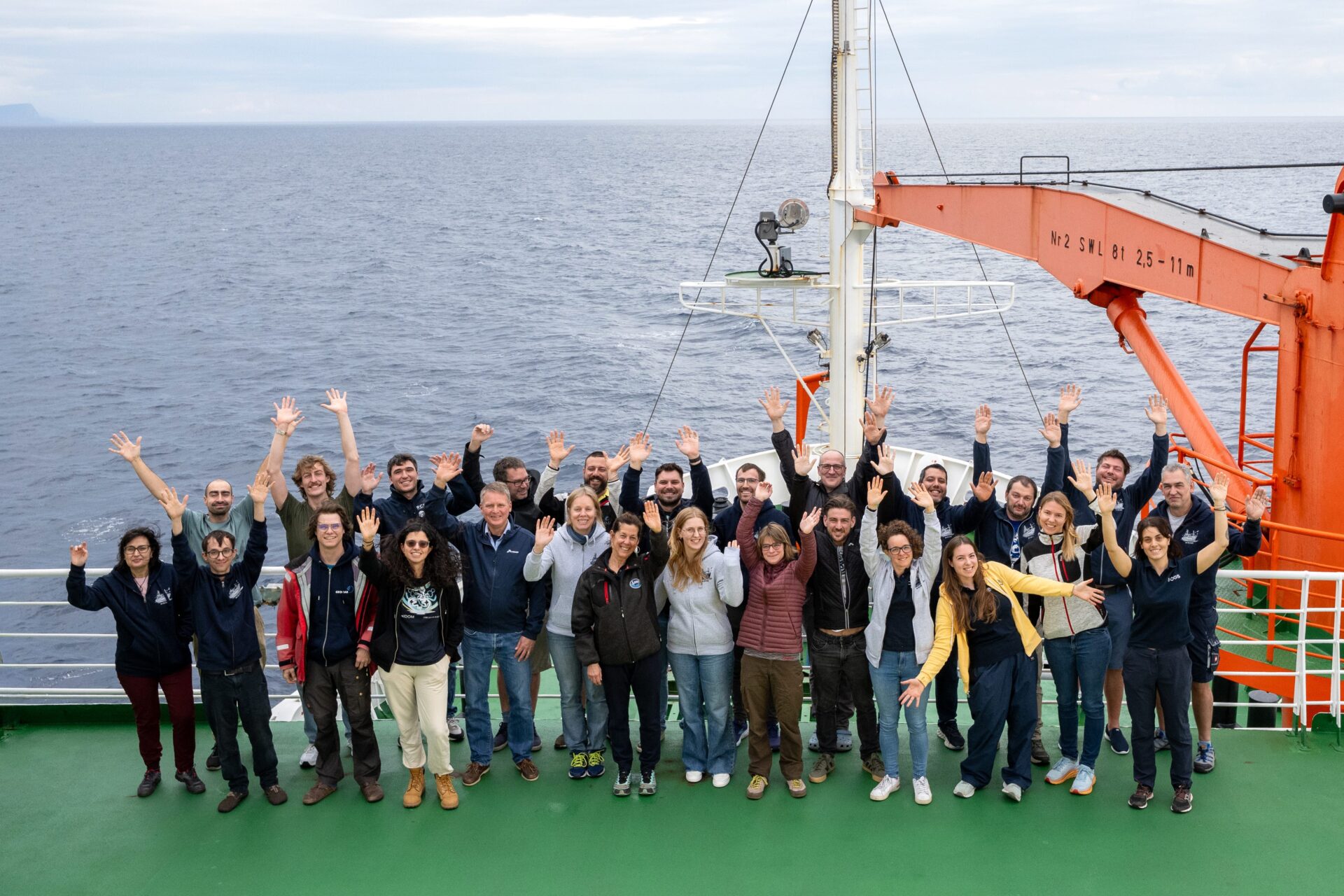
Several BioGeoSea partners took part in the scientific cruise M216 aboard the German research vessel Meteor, which concluded in Las Palmas on 9 February 2026. The expedition focused on collecting high-quality biogeochemical and biological data across the Mediterranean Sea and on testing new technologies to strengthen future ocean observing.
As part of the international GO-SHIP programme, researchers carried out full-depth sampling across the major Mediterranean basins, generating long-term observations that are critical for tracking environmental change. Preliminary findings show continued warming and salinification of the Mediterranean, along with increasing carbon storage throughout the entire water column, including the deepest layers.
In addition to advancing scientific knowledge, the cruise supported BioGeoSea’s goal of improving biogeochemical ocean observation by validating new sensors and methods, some designed for use on autonomous platforms such as Argo floats. Despite challenging winter conditions, the expedition successfully produced valuable datasets and underscored the importance of international collaboration in sustained ocean observation.
Earlier this year, several BioGeoSea partners participated in the scientific cruise M216 aboard the German research vessel Meteor. The expedition, which concluded in Las Palmas on 9 February 2026, focused on collecting high-quality biogeochemical and biological data across the Mediterranean Sea and testing new technologies for future ocean observing.
During the cruise, researchers sampled full-depth CTD profiles across the major basins of the Mediterranean Sea. Water samples were collected and analysed for a wide range of biogeochemical and biological Essential Ocean Variables (EOVs), either directly on board or later in laboratories of the participating institutions. The expedition formed part of the international GO-SHIP programme and represents the third full zonal section of the Mediterranean Sea within the past 15 years.
The long-term observations collected during these repeated expeditions are essential for understanding ongoing changes in the Mediterranean Sea. Preliminary results indicate that the Mediterranean is continuing to warm and become saltier, while also storing increasing amounts of carbon throughout the full water column — including the deepest regions, reaching depths of around 5,000 metres.
Beyond the scientific measurements themselves, the cruise also provided an important opportunity to improve the ocean observing system for biogeochemical EOVs, which is a central objective of BioGeoSea. Researchers tested and validated novel instrumentation and sensors, including technologies for measuring dissolved inorganic carbon and approaches to better assess ocean ventilation. Several of these technologies are intended not only for use during research cruises, but also for deployment on autonomous observing platforms such as Argo floats.
Despite challenging weather conditions during the winter campaign, the scientific teams successfully completed the expedition and generated valuable datasets that will contribute both to the understanding of Mediterranean ecosystem change and to the future development of integrated ocean observing systems.
The cruise brought together scientists, technicians and institutions from across Europe and highlighted the importance of international collaboration in advancing ocean science and sustained ocean observation.


