

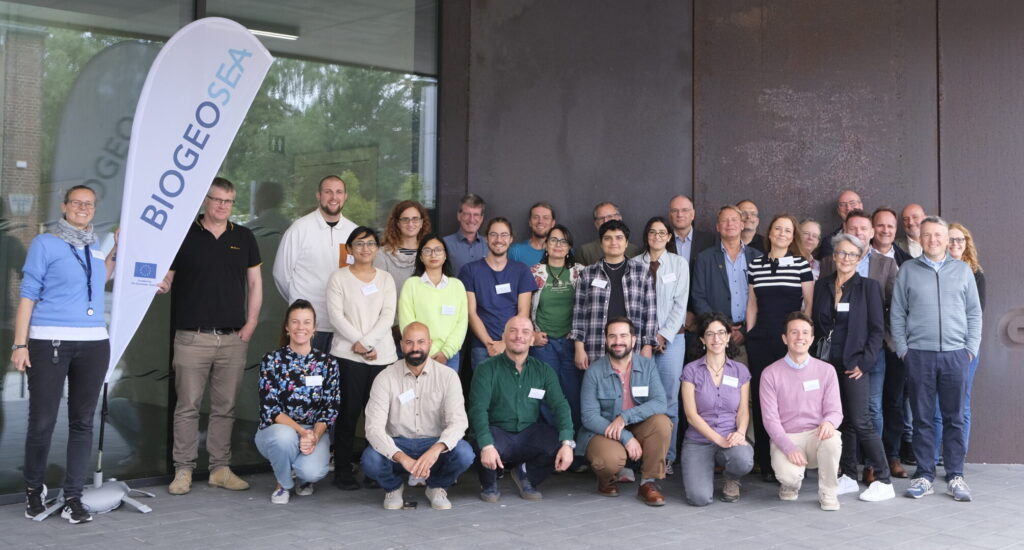
From 7–10 September 2026, the BioGeoSea consortium came together at GEOMAR in Kiel for its first Annual Meeting. Four days of scientific exchange, critical reflection and collaborative planning provided an opportunity to take stock after the first project year – and to sharpen priorities for the next phase of BioGeoSea.
One year into the project, the meeting brought together the BioGeoSea consortium, members of the Advisory and Foresight Committee (AFC), representatives of the European Commission and invited experts. The programme combined scientific and Work Package updates with open discussions, breakout sessions, poster presentations and two panel discussions. The aim was not only to review progress, but also to discuss challenges and align methodologies, data integration and next steps across the project.
Taking stock after the first year
Much has happened since BioGeoSea started in September 2025. During the meeting, the five Work Packages presented progress across the ocean observing value chain – from biogeochemical Essential Ocean Variables (EOVs), observing technologies and best practices to modelling, indicators, stakeholder engagement, exploitation and communication.
Discussions showed how closely these different components are connected. Work on the BGC EOV specification sheets and their maturity, for example, feeds into the development of indicators, while modelling activities aim to improve the spatial and temporal information available for phenomena such as ocean deoxygenation, acidification and greenhouse-gas fluxes. At the same time, work on data integration and visualisation is exploring how project results can eventually be made accessible and useful to different users.

Several sessions deliberately went beyond reporting progress. An open debate asked a fundamental question: Do we have the right biogeochemical EOVs? This was followed by a discussion on the progress, challenges and next steps of indicator development.
Questions around measurement practices and standards also featured prominently, including how best practices mature and how consistent observations can be supported across different observing networks.
Looking beyond BioGeoSea
Ocean observing cannot be advanced by a single project. Updates from BioGeoSea’s sister projects BioEcoOcean and ObsSea4Clim therefore formed an important part of the first day, providing a broader perspective and helping to identify opportunities for further collaboration and alignment across the three projects.
The wider European context was equally important. Larissa Lorinczi, BioGeoSea’s Policy Officer at the European Commission’s Directorate-General for Research and Innovation (DG RTD), provided first-hand insights into current developments around the European Ocean Pact, the EU Ocean Observing Initiative and the emerging OceanEye framework. We were particularly grateful that she not only shared the latest developments, but also took the time to engage in an extensive exchange with the consortium and answer questions from the plenary.
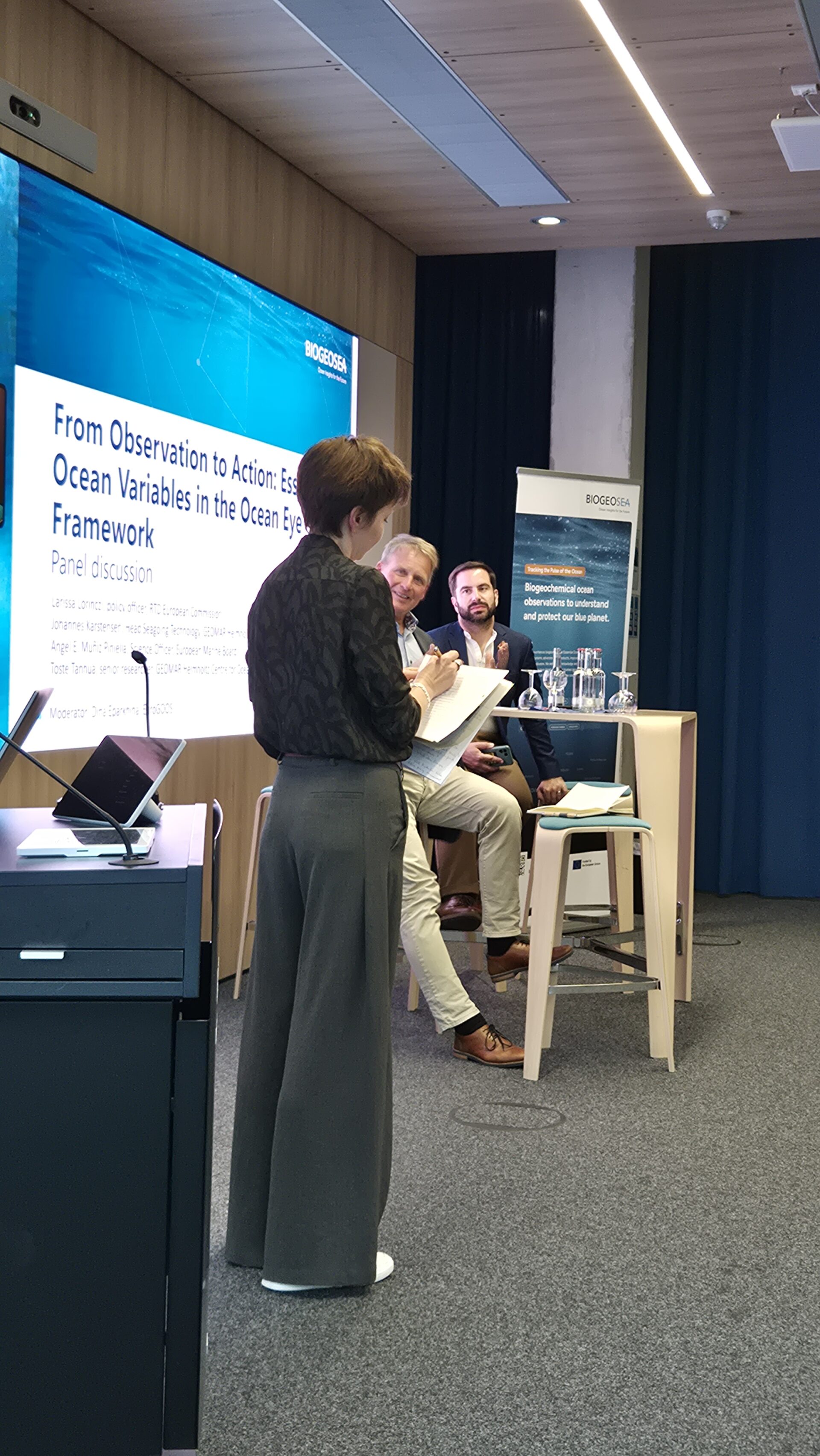
Building on these insights, the panel “From Observation to Action: Essential Ocean Variables in the Ocean Eye Framework”, moderated by Dina Eparkhina of EuroGOOS, broadened the discussion by bringing in additional perspectives on the evolving European ocean observing landscape. The exchange explored how scientific capabilities and policy and societal needs can be better connected as Europe moves towards a more integrated and sustained ocean observing system.
A recurring question was how to move from successful research-based observing capabilities towards operational and sustained systems – and how to ensure that the information generated by those systems reaches the people who need it. The discussion highlighted the importance of prioritizing observations, strengthening coordination and standardization, and better connecting scientific timescales and approaches with societal and policy requirements.
From observations to users
This question of who ultimately uses BioGeoSea’s results – and what they actually need – became one of the strongest threads running through the meeting.
BioGeoSea’s Advisory and Foresight Committee provided an important external perspective. Its members encouraged the consortium to strengthen engagement with operational oceanography, regulatory authorities and other potential users, and emphasized that stakeholder engagement and co-design should accompany product development rather than take place only once results are finished.
The consortium took these questions into its own working sessions. Participants worked in groups around BioGeoSea’s four main phenomena – ocean deoxygenation, greenhouse-gas fluxes, ocean acidification and the biological carbon pump – to identify priority users, determine where stakeholder input is needed and discuss concrete engagement activities.
The discussions also reached further along the pathway from observations to information. Sessions on software and visualization addressed how indicators could be presented for different users, how uncertainty should be communicated, which data and indicators should be prioritized, and how the resulting infrastructure might remain sustainable beyond the lifetime of the project.
On the final day, these questions were considered from another angle in the panel discussion “BioGeoSea in a socioeconomic perspective.” Invited experts joined the consortium to discuss how scientific information can be translated into meaningful and actionable information, how trust with stakeholders can be built, and how the societal relevance and impact of ocean observing can be strengthened.
Moving into Year 2
The Annual Meeting therefore did more than take stock. It helped identify where BioGeoSea needs to focus during its second year.
Priorities emerging from the discussions include further developing and testing the BGC EOV framework and indicators, strengthening collaboration between the scientific and exploitation activities, refining indicator visualizations through stakeholder feedback, and engaging more closely with regulatory, operational and private-sector communities. The consortium also discussed how project outputs could eventually connect to established infrastructures and services to support their long-term use beyond BioGeoSea.
The meeting also provided space for the conversations that rarely fit into online meetings. A tour of GEOMAR offered insights into the institute and its ocean observing activities, while a canoe trip on the Schwentine River and an evening together at the Kieler Förde gave participants time to continue discussions in a more informal setting.
After four intensive days, the consortium left Kiel with new questions as well as clearer priorities. The first year has laid much of the scientific and technical groundwork. The next challenge is to increasingly connect these components – from observations and EOVs to data, models and indicators, and from there to information that can be understood and used by science, policy and society.


